How Public Libraries add to Land Values

Karl FitzgeraldCommentaryLeave a Comment

An interesting report by the Fels Institute of Government (University of Pennsylvania) was quoted in Yes Magazine:

… [We] found that within 1/4 mile of one of Philadelphia’s 54 branches, the value of a home rose by $9,630. Overall, Philadelphia’s public libraries added $698 million to home values—which in turn generated an additional $18.5 million in property taxes to the City and School District each year. That benefit alone recouped more than half of the city’s investment.

More detail was found the Fels report:

Value to Homes and Neighborhoods

  • Homes within ¼ mile of a Library are worth, on average, $9,630 more than homes more than ¼ mile from a Library. For homes between ¼ and ½ mile of a Library, the additional value is $650.
  • Homes in Philadelphia are located, on average, about a half mile (.56 mile) from a Library; 95% of Philadelphia homes are within 1.13 miles of a branch, 75% of Philadelphia homes are within .73 miles, and 25% of Philadelphia homes are within .34 miles of a Library.
  • Libraries are responsible for $698 million in home values in Philadelphia. That’s an increase in home values that homeowners can borrow against to finance education, home improvements and other types of spending.
  • The additional home values generated by proximity to a Library produce an additional $18.5 million in property taxes to the City and School District each year. Under a scenario of accurate and timely assessments, this is how much property tax revenue could be lost per year if all libraries were closed.

The value of public works to the locational value of the home is undeniable. In our primer Land Value Capture for Infrastructure, we outline how public works often benefit the landowner many times over the cost of the project.

The new High Speed Rail 2 is a case in point. The UK’s Sunday TImes states:

Homeowners near these stations have cause to celebrate. Research by Savills shows that a one-minute reduction to a commuter rail journey adds £1,000 to the average value of a home.

People from all over the state/ nation are expected to pay for improvements that capitalise into higher land values in one particular location. In economics this is called leakage.

What have we done to deter such leakages?

On the contrary, with such windfall gains available, society has set up elaborate systems to promote them.

Infrastructure Australia, the peak body for public works funding by the Federal government, is one such organisation. Of the 18 person board, there is only one representative for the public interest – Mr John Fitzgerald, Victorian Department of Treasury and Finance, Commercial.

The 17 other members of the board have a vested interest to ignore the fact that public works deliver windfall gains to private owners of property.

From accountants specialising in infrastructure tax offsets, to heads of infrastructure companies to housing and construction heavyweights, one wonders how decisions are made at the Infrastructure Australia board level when so many must excuse themselves from voting with a conflict of interest over any given project.

Perhaps more public libraries will be built when similar reports are written in the Australian context…
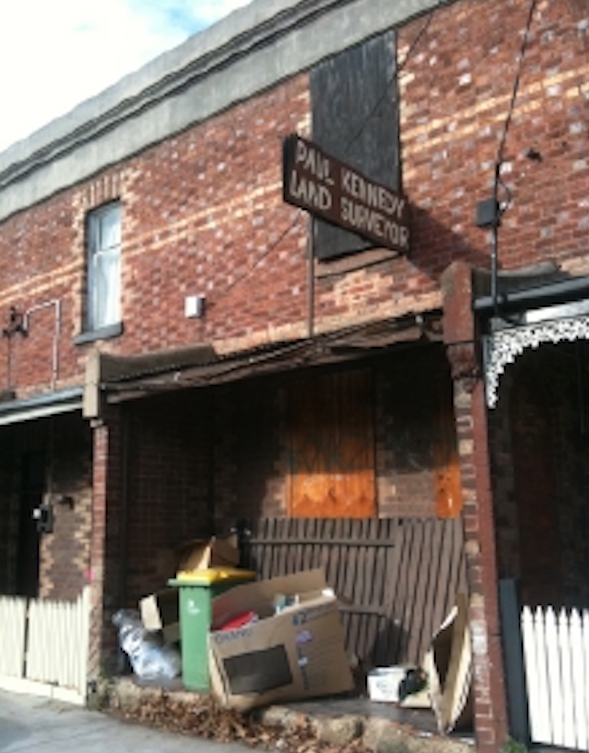
46,220 empty homes – the genuine housing supply issue

Karl FitzgeraldPress Releases2 Comments

“With 46,220 properties vacant in Melbourne, the myth we have a housing shortage cannot go on much longer,” Earthsharing Australia spokesperson Karl Fitzgerald said today.

Earthsharing’s Speculative Vacancies report highlights that tightness in rental stock does not equate to a lack of housing. The much quoted REIV’s 1.7% vacancy rate (Nov 2010) only refers to dwellings for rent, a subgroup of Melbourne’s total housing stock.

“Victoria’s Minister for Planning Matthew Guy is relying on poor data in contemplating to sprawl Melbourne even further when 46,000 homes lie dormant.

“Capital gains for Melbourne properties averaged $120,000 in boom years like 2009. Why would all investors bother to rent out a property for $17,000 when they could hold some of their portfolio empty to enhance massive capital gains?” asked Fitzgerald.

“When iconic suburbs like Carlton South have Estimated Genuine Vacancy rates of 11.5 per cent, Melbourne East 18.5 per cent and Docklands a staggering 23.32 per cent, there is something wrong with the economic incentives society feeds off” Fitzgerald said.

The report analysed 64 per cent of Melbourne’s residential stock using water meter data supplied by City West Water and Yarra Valley Water. Dwellings using under 50 litres a day for 6 consecutive months were deemed vacant.

“Extrapolating this to all Melbourne real estate, there are over 61,000 empty homes and apartments lying empty.

“The Speculative Vacancy report is an urgent warning to potential buyers. This is not the time to make a life-long commitment to buy a home – the market is flooded with stock as investors bail out of the market. With supply overwhelming demand, prices must fall.

“First home buyers are being told it is a ‘buyer’s market’. “Transitioning from one of the world’s biggest property bubbles into a genuine buyers market is a process that takes years, not days.

“SQM Research’s figures on the volumes of Melbourne houses offered for sale shows a staggering increase. March volumes are up an enormous 48 per cent compared to last year; April is up by an even larger 68 per cent over 2010.

“Buyers are being deliberately misled by incomplete statistics further transformed by real estate ‘spin’. We urge the federal government to instruct the ABS to collect and publish a monthly statistical series on housing vacancy rates in the interest of a fully informed market”

“Experienced players in the land game know the bubble has peaked and have already sold out.” Fitzgerald concluded.

Read the report

Speculative Vacancies Distort Supply & Demand

Karl FitzgeraldPress Releases9 Comments

Australia’s endless debate about property prices pivots on the balance of supply and demand.

Earthsharing’s Speculative Vacancies in Melbourne 2010 Report demonstrates that nearly five percent of all houses in Melbourne are simply empty and unused.

The report identifies and measures the scale and extent of speculative vacancies – properties held out of use in the pursuit of capital gains – using water meter data collated by the various utilities.

“The REIV consistently points to it’s Rental Vacancy rate of 1.7 per cent as the sole measure of vacancies in Melbourne,” Earthsharing Research Director Karl Fitzgerald said today at the release of the report. “Our survey shows one in twenty houses and apartments are just sitting there vacant.

“Recent increases in house prices have been driven by speculation, not a housing shortage. Property owners are restricting the supply of housing by holding properties off the rental market.

“We estimate the Speculative Vacancy Rate for Melbourne in 2011 to be 4.94 per cent or 46,220 of 935,305 properties surveyed.

“More than 20 suburbs surveyed had estimated vacancy rates in excess of 8 per cent. There are notable hot spots in Docklands, Williams Landing, East Melbourne and Truganina,” Fitzgerald said.

“Supply and demand in these suburbs is significantly mismatched and should be monitored carefully for distress as housing prices recede.

“Docklands (23.3 per cent vacant) is particularly interesting as builders there have been obliged for some years by their financiers to offset risk by pre-selling a very substantial proportion of apartment before commencing construction. The vacancies there are largely owned by individuals, many of whom paid a very small deposit and signed a water-tight contract obliging them to pay the remainder on completion. These contracts are coming due just as the price trend turns down decisively,” Fitzgerald concluded.

Read the report

Speculative Vacancies in Melbourne 2010

Karl FitzgeraldCommentary9 Comments

Author: Tom Curtis
Research Director: Karl Fitzgerald

Executive Summary

We estimate the Speculative Vacancy Rate for Melbourne in 2010 to be 4.94% or 46,220 of 935,305 properties surveyed.

Our Estimated Speculative Vacancy Rate is more than twice the REIV’s Rental Vacancy rate for the same period of 1.7%. The rental vacancy rate is the rate most commonly referred to in media coverage as ‘housing vacancy’.

Recent increases in house prices have been driven by speculation, not a housing shortage. Property buyers are restricting the supply of housing by holding their properties off the rental market.

More than 20 suburbs surveyed had estimated vacancy rates in excess of 8%.

15,237 properties surveyed consumed on average 0L of water per day.

The Speculative Vacancy rate was down from 2009’s rate of 6.84%. It is unclear how much of this fall is from an improvement in property usage and how much is attributable to changes in methodology/sample.

This report sampled 64% of dwellings in Greater Metropolitan Melbourne.

Download the 2010 Speculative Vacancies in Melbourne report

Introduction

The Speculative Vacancy 2010 Report sets out to answer the question ‘how efficiently is housing allocated by the market?’ We specifically look at properties in greater metropolitan Melbourne.

How many are empty?

Reported vacancies of 1.7% reflect the rental market. These are published and acted upon by the Real Estate Institute of Victoria (REIV), as at November 2010.

This report seeks to measure the vacancies in reality, regardless of property rights. It looks at whether there is a ready and waiting housing supply to provide homes to people who want to live in Melbourne and which could potentially provide lower costs of living through greater competition in the rental market.

This report will be of interest to those concerned with social and economic justice, and those concerned that Melbourne may have a property asset bubble. Vacant properties can be used to create a supply side shock and deflate the housing bubble dramatically. The genuine vacancy rate is a key factor in determining how big that bubble is.

About Earthsharing

Earthsharing Australia is a self-funded non government organisation, of people from all walks of life inspired by the economic justice that can be achieved by distributing the wealth produced from land among the entire community.
www.earthsharing.org.au

Methodology

The Speculative Vacancy Report follows the methodology used in the ‘I Want To Live Here’ reports (2008 and 2009). This involves obtaining data regarding the consumption of water at serviced properties. Water consumption is used as a proxy measure of vacancy. In this, and in previous reports, we assume that an average daily water consumption of less than 50L over six months indicates vacancy.

There are limits to this methodology. The 50L/per day maximum is significantly lower than Victorian Government campaign targets for daily individual water usage. A leak, such as a dripping tap, can consume up to 200L per day. An unoccupied dwelling may have an active sprinkler system that pushes water use above 50L/day.

Conversely, somebody who commutes between residences (e.g. occupying their Melbourne dwelling on weekends only) may end up achieving a daily average less than 50L. Therefore, it is possible our figures can understate or overstate vacancy for any given property.

However, the simplest and most likely explanation for low water consumption remains vacancy. We therefore provide a ‘definite’ speculative vacancy rate for properties averaging 0L per day, and an ‘estimated’ speculative vacancy rate for properties averaging 0-50L per day.

Findings

We successfully obtained the required data from City West Water and Yarra Valley Water. A third provider, South East Water, did not provide the data requested.

Data was organised by suburb. Suburbs where the total properties serviced (by both providers) were less than 100 have been excluded from our findings. For example, East Keilor had three properties serviced, only one of which met our definition of vacancy. This would lead to a 33% vacancy finding, which we feel misrepresents the true state of vacancies in the suburb. Therefore East Keilor has not been included in this report.

Overall, 935,305 properties were included from 261 suburbs. This represents 64% of the total dwellings captured in the 2006 Census for the Melbourne statistical division. Of these, 15,237 properties consumed 0L of water per day over the last six months and are definitely vacant. We estimate true vacancy to be as high as 46,220 properties or 4.94%. Almost 5% of properties consume less than 50L of water on average a day.
Read More