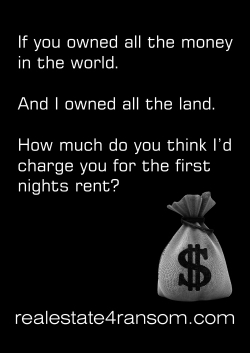
If you owned all the money in the world…

Karl FitzgeraldMultimedia2 Comments

That was the statement Red Symons of ABC breakfast radio ran as a lead in to our 6.45am discussion this morning. It is also the opening line in the film, attempting to settle those who blame banking and the money system for everything.

Listen to the interview with Red promoting our debut documentary Real Estate 4 Ransom.

Tickets are available at ACMI for the preview screening of Real Estate 4 Ransom this Wednesday at 7pm. A short Q & A will follow with myself and Co-Director Gavin Emmanuel.

Check our R4R facebook group or twitter for more.

Speculative Vacancies and Real Estate 4 Ransom

Karl FitzgeraldCommentary1 Comment


Download the Speculative Vacancies report

As written up in The Age today, p5:

Speculators ‘locking up’ empty dwellings that could be homes

Michelle Griffin

PROPERTY speculators have locked up 46,220 empty homes in metropolitan Melbourne, the housing campaign group Earthsharing Australia says.

In a documentary soon to be released, Real Estate 4 Ransom, the group says that 4.95 per cent of the city’s potential housing stock is unoccupied, double the rental vacancy rate of 2.4 per cent published last week by the Real Estate Institute of Victoria.

While the institute calculated the volume of available rentals by taking a sample from 45,000 tenancies on the books of its member estate agencies, Earthsharing used water-meter data supplied by City West Water and Yarra Valley Water to determine which residentially zoned properties were empty.

Dwellings using less than 50 litres a day for six consecutive months were deemed vacant. At the height of the drought in 2008, average household daily water use in suburbs with stage three restrictions was about 140 to 160 litres a day.

The group’s Speculative Vacancy Report says that in Docklands, almost a quarter of residential properties there, 23.32 per cent, are vacant. The official vacancy rate for Docklands is 3.62 per cent.

Other established suburbs with many empty homes, according to the report, include East Melbourne (18.64 per cent), Carlton (11.51 per cent) and Essendon North (13.07 per cent).

A spokesman for the Tenants Union of Victoria, Toby Archer, said he regularly heard from tenants who reported that houses sat empty for more than a year after they were evicted by new landlords.

“The report highlights that there may be more houses potentially available to renters than the indicators developed by the REIV,” Mr Archer said.

Earthsharing director Karl Fitzgerald admits that properties with no water usage could include vacant blocks, derelict houses and even homes with water tanks.

But he says the estimates may be conservative, considering apartment blocks or townhouses could be built on many blocks.

“Local councils always overvalue the house and undervalue the land,” Mr Fitzgerald said. “It gives a huge economic incentive for the owner to smash the house down. You could spend $5000 to fix the holes in the wall and make it fit for tenants, but for many property investors, the main thing is to sell this property. The land is the valuable thing.”

To fund the $50,000 documentary about land banking and tax reform, Earthsharing drew on funds realised when it sold off two properties at the height of the boom in 2008, an office building in Hardware Lane in the city and a commercial property in Coburg.

“I used to be really embarrassed [by the properties]; we’ve got to put [them] to use,” Mr Fitzgerald said, adding that the documentary was ultimately an argument in favour of the Henry Review’s proposals for land tax.

Carbon Tax Positives

Karl FitzgeraldCommentaryLeave a Comment

The Gillard Government’s Clean Energy Future plan signifies that the game is up for the free rider’s polluting our planet.

The Carbon Tax of $23 per tonne of carbon for July 1 2012 – June 30 2013 sends a clear message that polluters must pay. In this age of compromise politics, the industry lobbyists who seem to have won are the steel manufacturers. The ALP’s union links have been rewarded. The coal and mining lobby have lost out. But have no fear, Gina Reinhart has no doubt flown Lord Monckton to Australia to represent their interests.

Land Locked
Of immediate interest will be to see how land prices in sun drenched locations near major power transmission lines behave. If it is anything like California’s Mojave desert land rush, land prices there will sky rocket. Land speculators will get in first, with solar operators forced to pay more for land to meet their ransom price.

Rainforest land values
How will land prices for carbon sinks in the Pacific Islands react to this announcement? One expects there to be a gold rush of land grabbing for rainforests. Reports of cashed up mining companies hedging their bets has been prevalent for a number of years.

We remind you that these precious carbon sink resources, the lungs of the world, will only get more valuable in the future. Selling carbon permits off per annum is a much more sustainable solution for tribal elders. Then when carbon prices increase to $100 – $200 per annum, they get a share of the rising prices too.

Selling rainforest lands outright should be avoided at all costs.

Pressures on Housing
The exemption of petrol form the carbon tax means that sprawling home owners won’t be penalised. Some in the housing industry are complaining:

“Competing against imports from non-CO2-e taxing countries, Australian building product manufacturers face a cost collage as the carbon tax is passed on down the line into the inputs for each production and fabrication phase,” HIA Chief Executive Graham Wolfe said.

Construction costs have largely flat-lined during this land and house price boom. However, there is next to no commentary from the HIA on the role of land speculation in holding prime locations bare and forcing the rest of us to travel further to our work, our home.

Land speculation is an issue that will increase in importance as the drive to a more sustainable future becomes intrinsic to humanity’s survival. Listen to this recent podcast where second only to energy production was the importance of living in central locations (as the surest way to reduce our carbon footprint by 70%).

Some are complaining that Negative Gearers would be hurt by the rising of the tax free threshold from $6000 – $18,200. This will deter property investment/ speculation as there will be less of a tax write off for those hard working property flippers. This is a good thing. First home owners and the market in general continue to prefer established housing in centralised communities, rather than McMansions in ‘Master Planned Communities’.

Some commentators are concerned at the $4 billion budget hole over the next four years from the Clean Energy Future package. Compare that to some $24 billion we will be giving to negative gearers to both bid up existing house prices and support the building of unwanted McMansions in unwanted areas.

The Big Sell

Now we are set for a campaign like fever of salesmanship from both PM Gillard and Opposition leader Abbot. When will anyone in politics use the golden words ‘tax switch’ as a means of describing this momentous shift?

To see Abbot in his fluro vest working amongst the people, one wonders when a government MP will hit him over the Mining Tax. Abbot wants small business in manufacturing and services to pay the same company tax rate whilst miners benefit from record price gains for their products. That does not sound like a strategy towards lowest operating costs. It sounds like the end of the eastern seaboard manufacturing industry. The Liberal Party have become little more than a protectorate for monopolists, rather than the shepherds of efficient pricing systems.

Land Value Capture

Our aim for a sustainable society will not be maximised until we adopt a Geonomics system, where the earth’s scarce values are recycled back to the community. Page 7 of today’s AFR reported the high cost structure of the proposed high speed railway as one of its biggest hurdles to competing with discount airfares. Melb – Sydney is the world’s fourth busiest air route. A high speed train emits 1/4 of the greenhouse gases per person than what air travel does.

Land values along this train route would sky-rocket, especially at linking train stations. The $32 – 59 billion infrastructure price tag could be met if landowners paid back just 6% of the windfall land price gain they receive from this new service (over 20 years). Then train ticket prices could reflect the Marginal Operating Costs, keeping their price structure low.

That would certainly continue the positives.

Prof Peter Newman on Infrastructure Financing

Karl FitzgeraldMultimedia3 Comments

Renegade Economists Podcast 188

Subscribe to the free podcast here

Professor Peter Newman (Curtin Uni) joins us for an in depth discussion on the peak oil era and the cities we will need. We examine the report he co-authored with Trubka and Bilsborough – Assessing the Costs of Alternative Development Paths in Australian Cities. (PDF 627 KB)

Points of note include how inner suburban living can save 4400 tonnes of greenhouse gases per 1000 homes (for more on this pls listen to the recent podcast with Dr Robert Crawford as per below). Some of the stats reeled off are from Table 4 of the report ie the additional cost of policing the sprawl is $388,416.

Prof Newman discusses how Land Value Capture is world’s best practice in financing infrastructure. How does it curb sprawl? Read about the Gold Coast Rapid Transport Corridor and the role LVC can play.

Listen to Prof Peter Newman
Listen to the recent show with Dr Robert Crawford discussing how location is the biggest determinant to our carbon footprint.

The above photo is of the bombsite opposite Melbourne’s Spencer St station. Vacant for over a decade, this picture is endemic of the game that land speculators play in undermining community and enforcing sprawl. The land value gains land bankers enjoy should be recycled back to the community, funding the new network of magnetic trains we so need.