Renegade Economists podcast 238
As broadcast on 3CR, Wed May 16, 2012

Listen to the interview
See other past interviews.
Subscribe to the free weekly podcast
KF: Karl Fitzgerald
AH: Alanna Hartzok
KF: This week’s special guest on the Renegade Economists is Alanna Hartzok. Alanna is the author of “The Earth Belongs to Everyone” and many of you may well have seen her when we toured Alanna through Australia in 2006. Alanna is our United Nations representative and an old friend here on the Renegade Economist, so Alanna, welcome to the show!
AH: Thanks so much Karl, good to hear from you.
KF: Now this story is an old one, just how old is it?
AH: Oh, five or ten thousand years!
KF: The earth belongs to everyone, that’s been one of the seminal teachings over this huge timespan.
AH: Absolutely, and I’m holding here a little book, called “Economic Principles in the Vedic Tradition” by a Greek guy named Nicholas Kazanas. He has traced this fundamental idea back through the Vedas, which were formative for Hinduism, Buddhism and the whole Asian philosophy and religions, to about 3000BC and the recorded history from those times, that for a society to be stable, for it to be fair, for it to be prosperous, there has to be an honouring, in practice, of the principle of fair share rights to land and resources of the planet. So he spells this out pretty nicely in this little book, even using some of the Sanskrit terms for it, and bringing it from that time period up to Adam Smith, the physiocrats, and Henry George’s idea of land value taxation, which in the past few years, I have called the “golden thread” of perennial wisdom teachings around economics.
And we have also traced it through the Judeo-Christian-Islamic tradition, rooted in biblical laws of Leviticus – laws of jubilee, allocating fair land rights to the original tribes of Israel, even to the point of charging a cash fee to those who have better locations, meaning locations closer to the market centres, paying that fee to those who were located further from the market, thus with a disadvantageous location. And land value taxation is essentially that – it’s a hire payment for those better land, better located lands, more valuable or greater amounts of land holdings than others, to equalize labour’s rights to land and resources.
KF: And it’s interesting when you talk about such ancient history and Judeo-Christian teachings, you have to come to the term “tithings”.
AH: Tithings, and that was 10%, usually, of your earnings. The earnings in ancient times were quite a bit from the land – crops and so on. Interestingly enough, one of the prescriptions for the land value tax policy is to collect 10% of the land value, and that would be considered a full land rent. Now, there’s a little controversy about that, but that number does come up, of 10%, which would capture significant land rent.
KF: And these major institutions such as the church, who knew about the value of the Earth, have somehow become wrapped up in the whole land game themselves, do you have any comments on that?
AH: Oh my goodness, that is the story of our planet Earth for the past millennia. It’s been, as I see it, a power struggle between those who would use power for the good of all, and thus create a just society, versus those of a more limited awareness that are just in their state of ‘evolution’ quite egocentric, and can only see their individuality and maybe their family and their tribe, if you will, and are in competition and see the others as outsiders, seeing it as fair game to try to take as much as you can from the other – they have become very powerful and there are cycles when that limited consciousness supersedes the ones who would have fairness and justice.
Walter Brueggemann, the theologian who wrote a wonderful book called “Land and the Bible”, says that the bible could be read from the stories of land lost and land gained. If you think about it, it is one group going into diaspora, going into their wilderness experience, being pushed off their land and then fighting for their struggle for their right to return to their land, and often pushing others off in the process. Then you come to the middle-east, for instance, whose land does that belong to, the Palestinians or the Jews? As soon as you draw a circle around that that includes everyone, you say “Okay, it’s not yours or mine, it’s ours.” And we could do that with the whole Earth – it’s ours. And then the question is then, how do we share it? How do we share what is ours? Just as a family would share their common wealth, we share the common wealth of our planet. So, it’s an ancient wisdom teaching – when there are times of injustice, war, poverty and great gaps between the super-rich and the rest, as we have now, the search deepens and, invariably, people come across this wisdom teaching and struggle to bring it forth, and that brings us up to this very moment – our conversation right now.
KF: Well it certainly does and in terms of major institutions, there is barely any bigger than the World Bank, and for a long time, people have questioned what side of good or bad they are on, and you went into the heart of the beast, recently, tell us about your recent dealings with the World Bank!
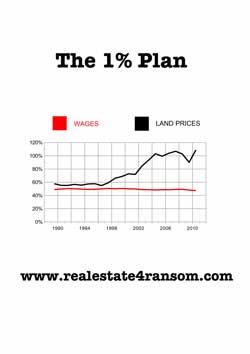
AH: Oh, thanks, Karl, it was the heart of the beast, and I found some great friendliness there towards these ideas of this wisdom teaching, much to my amazement! This was the World Bank Land and Poverty Conference, it was called, in Washington at the Bank headquarters, April 23rd – 26th. Now, I think the first one was 2005 – it started with a couple of dozen people, it has been growing: last year there were two-hundred and fifty, this year there were more than five hundred people, and it was over-subscribed. What is happening is that there is more and more of a global focus on the land problem. We’re all hearing about the land-grabbing. We all know that there is something around the housing crisis – that land prices and thus housing prices go up faster than wages, and this is being experienced world-wide. And this was a world-wide conference, a truly global conference – people from all continents were well represented, and some really excellent thinkers, researchers and academics were giving papers. And I was able present in a poster session – a lot of these types of conferences have professional poster sessions, and some of you in Australia helped me out a bit – Bryan Kavanagh’s graph was included in my poster, showing that one third of GDP is surface-land rent in Australia. So my poster was called “Land Value Capture and Resource Rents for Public Revenue: Addressing Inequality, Poverty and the Land Rent Problem”. I also was a discusser in a panel, for a series of papers that included one by Dr. Lawrence Walters, professor at Brigham Young University. Walters started his paper with a quote from John Stuart Mill, one of the best quotes from Mill showing the issue around the land rent problem, and he also mentioned Henry George – he quite understands the land value tax, as did the presenter Thiago Oliviera from Brazil. The conversation through the entire week was on issues of concern to us – land rights, land valuation, land taxation, how to do good land maps, which is of course a precursor to doing good land value maps. So, I was really impressed.
KF: Can you step back and look at some of the World Bank policies over previous decades that have been a concern to us in terms of capturing this naturally rising value of the Earth?
AH: Well, there has not been sufficient attention paid to the power of taxation to create or to destroy when these World Bank loans are made. I had the opportunity to speak for one hour in the offices of the Dean of World Bank Board, who is also one of the Executive Directors, and two of his Chief Advisors. And I talked for 45 minutes, and they talked for fifteen minutes, and really listened very respectfully, and something is going to come out of that because they were definitely interested in land value taxation from that conversation.
During our talk, I had mentioned that about 8 or 9 years ago, there was a massive protest against the Bank and the IMF, and I was outside with a hundred thousand-plus protesters along with Joseph Stiglitz who was formerly a Chief Economist at the World Bank, and he had been fired because he was speaking out against the policies. Well, this gentleman who I spoke with had been in the Bank for fifteen years and he said that that was his critique, that the Bank was not good at listening – it came in with pet formulas and just told countries what to do, what kind of structural adjustments or how they needed to form their public finance and government structures in order to receive loans, very rigidly. And often those loans were not made with democratic participation – they were often agreements with corrupted heads of states or public officials, who then simply pocketed much of that money, and if the money was spent for infrastructure or human needs, the people had to finance that out of their own pockets rather than out of the increase of the land value that always happens when there are infrastructure or improvements made, it always increases the land value. And if that land value is not captured back to pay for the loan, then that is a boon for the landholders, which ultimately leads to land speculation and the situation where the average worker cannot afford the average cost of a house – a basic necessity like housing becomes out of reach for more and more people under these kinds of structural adjustment programmes, so I like to talk about a “people’s structural adjustment programme”, which is a land value capture/land value taxation system. And I like the word “adjustment”, you know, it means “add justice” – so if we really want to adjust we need to add justice!
KF: I like that, add justice! Good! And, our economic story goes back – as you mentioned earlier – thousands of years, and for that reason, many in this new mathematical “Post-Autistic” era of economics have written us off as an irrelevant story, and I’d just like your commentary on this last four or five years in global recession how times have changed.
AH: Well, I was communicating with Fred Harrison before I went to this bank conference and I said that Paul Collier was going to be a keynote speaker. And he said that he had written about Collier in his Silver Bullet book – that Collier was talking about the “resource curse”, saying that it would be better if developing countries did not have valuable resources because it just becomes a curse and a bane. In fact, Collier is now singing our tune. He said that “density is valuable and the value is reflected in the price of land. The taxation of land appreciation offers huge scope for financing the cost of urban infrastructure.” So, he was talking about the great need to socialise – imagine, in the World Bank, a keynote speaker talking about socialising anything! – But, he said that land rent is an enormous sum that should be socialised, and that the land rent of extracted resources should pay for infrastructure, like transport.
KF: That is really exciting, then, that this meme of the “resource curse” may well be ending, because it has driven me absolutely mad that people like Jeffrey Sachs have gone around the world talking about this resource curse and basically telling people that there is no way out of it. And here we are, saying, look, there are so many initiatives that Transparency International have been putting forward to avoid corruption, and of course, capturing the resource rents, it is so much easier.
AH: I almost fell off of my chair, I’m telling you! Now, he is from Oxford University, a globally well-known, highly respected development economist. And here is another statement from him: “Enormous rents on rising land value – such big money should not go to corrupt politicians, but these rents should be socialized.” Well, I was the first one to hop up and ask a question. And I said “I think you might have answered my question already, but is this really what you are intending to tell us?” And he said “Absolutely” and he repeated what I just told you that he said. A few people in the five hundred plus probably understood the significance of it; others have a learning curve ahead of them, but I’m telling you there were some of us there who really understood the importance of what Collier said. And he was introduced by one of the top people at the Bank, and he gave that first keynote talk to everybody – that was how it started.
Now, I do not agree with Collier on everything – he belittled peasant agriculture, so he is more on the big scale agriculture than I would go, but the point is if you bring in a full land value tax system, you are going to get an appropriate size and type of agriculture that would not have subsidies, that would be fair and that would probably look like the kind of organic, sustainable agriculture that many of us advocate.
Read More