Over 90,000 Empty Houses Amidst Housing Crisis

Karl FitzgeraldCampaigns, Hot Issues6 Comments


20 June 2012

There are 90,700 vacant houses in Melbourne – 5.9 per cent of the total – according to Earthsharing Australia’s 5th annual Speculative Vacancies Report.

“Our lazy land use makes a mockery of the drive for affordable housing,” researcher Philip Soos said today.

Vacancy hotspots include: Docklands 14.1%, Williams Landing 13.5% and Truganina 12.9% where construction has clearly outstripped demand; and a wide swathe of western suburbs with vacancies around 10%.

“The eye opener is that the latest REIV vacancy of 2.3% must be added to these findings. Politicians should be concerned that a 9.1% unemployment rate for our most precious resource exists in the CBD. Idle land leads to idle labour.

“The Earthsharing survey measures actual activity based on water consumption. It reveals widespread vacancies, despite the strenuous efforts of the real estate industry to convince us otherwise.

“The REIV rental vacancy statistics on which the media and public rely are fragmented, incomplete and contain a significant downward bias. They do not include properties held by speculators. They do not include properties being drip fed to the market in ‘staged releases’. They are misleading and should be condemned.

“Would it be ethical for your local pharmacist to drip feed life saving cancer drugs to the market at progressively higher prices? Would it be acceptable to do this against a fabricated background of drug shortages? The national outcry would end this immediately.

“First home buyers and renters are being deceived. In an affordability crisis, they deserve better information on which to make the biggest financial decision of their lives.

“Reporting artificially-lowered vacancy rates hoodwinks renters into accepting rent increases, prompts over-investment in property, and cows government into adopting policies agreeable to the real estate industry.

“Our survey tells a different story. Australia has one of the most generous residential property taxation regimes in the world. Capital appreciation has dwarfed rental income for years. Withholding properties from the market is a rational investor strategy.
The National Housing Supply Council claims a 228,000 housing shortage nationwide. We say, there is nearly half that locked up here in Melbourne.

“Given the towering value of the land market and its central role in all human activity, government is remarkably apathetic about investigating its workings, preferring to further expand the urban growth boundary and enrich land bankers.

“High quality statistics are possible in the information age at relatively little cost. If a little NGO like Earthsharing can do it, why not the Victorian and federal governments? The importance of accurate housing vacancy information is of heightened concern as we see California, Ireland and now Spain bulldozing houses in regions that were reported to have property shortages before their housing bubble burst.”

Download the Speculative Vacancies in Melbourne Report 2012

You are invited to attend this Thursday’s Speculative Vacancies Report release, 6.30pm, 1/27 Hardware Lane, Melbourne

Lobbyocracy Rules

Karl FitzgeraldCommentaryLeave a Comment

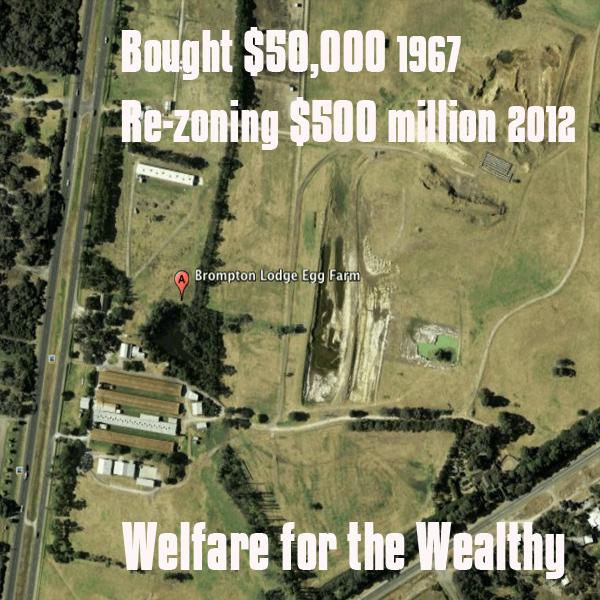
Taken from today’s LIberal Donors Win Big from Rezoning by Royce Millar:

The 100-hectare property was purchased as a bush block by the Carpenter family for $50,000 in 1967. Developer Watsons has estimated its developed value at up to $500 million.
..
Yesterday Parklea chief executive Andrew Facey confirmed being an enthusiastic Liberal supporter. He said he had contributed thousands of dollars to the Liberals ahead of the 2010 election, had attended numerous fund-raisers and was a member of Liberal fund-raising bodies including the local Berwick Ranges 500 Club. Last year The Age outed the Berwick Ranges among a string of such clubs that had breached electoral laws by failing to declare themselves to the Australian Electoral Commission.

Mr Facey also told The Age that he had given thousands of dollars – the exact amount is unclear but maybe $3000 – directly to the ultimately successful campaign of aspiring Gembrook MP Brad Battin.

The inclusion of Parklea’s property will allow the developer to transform farmland into housing worth hundreds of millions of dollars.

In NSW developers are banned from making donations to political parties.


This is a photo of the land in question.

Lobbyocracy is the hypocrisy of democracy. One Vote One Value has been replaced by One Dollar for One Decision! The Age online poll associated with the Millar article asks ‘Do you have faith in the State Government’s urban planning?’ 91% no, 9% yes.

The motivation for such legalised corruption is enhanced by our failure to tax the free lunch.

A higher Land Value Tax is a counterweight to naturally increasing land prices. Take two blocks of land. One paying no Land Tax, the other paying it. Over 20 years, a rational investor would pay the same amount in total.

We have been lured into believing it is better to pay mortgage debt and the 125 taxes we endure, rather than a simpler, less costly system. 70% of our tax revenue could be funded out of these naturally rising land prices.

Said another way, why pay banks 70% more than we should, when we can use that expenditure stream to remove the taxes that make things more expensive? That’s why so many government reports are coming out in favour of this more efficient tax base.

Such a system would also ensure that valuable prime locations are used for productive rather than speculative purposes, as our Speculative Vacancy Report next week will again highlight.

Speculative Vacancies Report release

Karl FitzgeraldEvents3 Comments

Thursday June 21st, 6.30pm
Presenter: Philip Soos
Prosper rooms, 1/27 Hardware Lane, Melbourne

RSVP – gold coin donations

Exciting young researcher Philip Soos is set to release our 5th Speculative Vacancies report. In the past, this report has been a lonely voice shining a light upon the lazy use of land in prime locations. Phil has surveyed over 1 million homes and has extensive findings on commercial vacancies. The figures are jaw dropping in light of the recent re-zoning windfalls handed out to developers.

Read the report

Epitomising the poor use of land is the associated picture. This location (corner of Barkly St and Commercial Rd, West Footscray) has been vacant for over 5 years and is not included in current vacancy calculations. This allows property speculators to create a media atmosphere that there is nowhere to live. ‘We need more land’ is the catchcry. Over time, sections of the site have been drip fed to the market to maximise profits.

Now that the land market is plummeting in Melbourne (with a 42% fall in land sales over 12 months to March 2012 ), the cheeky land baron has decided to put the location up for lease! This epitomises the real estate 4 ransom mentality and the importance of more accurate vacancy figures.

Philip is a highly rated writer with:

Read Earthsharing’s past Speculative Vacancy Reports and associated media.

Windfall Welfare

Karl FitzgeraldCommentaryLeave a Comment

Planning Minister Matthew Guy has just handed his mates a conservative $420 MILLION dollars.

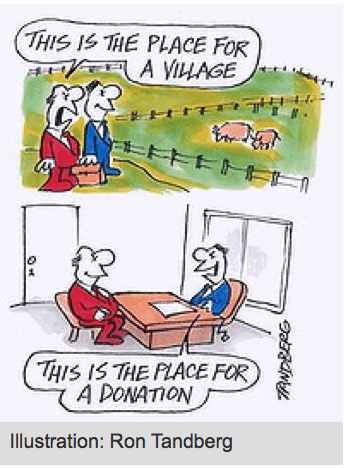
The 7000 hectare expansion of the Urban Growth Boundary is the equivalent to a golden pen tick, turning those who are lucky enough to own land in the right locations into millionaires. Urbis calculates that a $60,000 windfall is delivered to each re-zoned hectare near the UGB. This re-zoning results in a $420 million windfall.

Quite simply, this is welfare for the wealthy.

Thanks to the golden pen tick, this is a leakage in economic wealth from publicly created land value into private hands.

The windfall will be lightly taxed, with one hectare to pay $95,000 in a one off fee, which at 16 dwellings per hectare takes close to $6,000 per dwelling.

As previously stated here, the GAIC is less than perfect.

Urbis calculates the golden pen tick’s value at:

  • Land outside but near urban growth boundary $50 000 – $100 000 per hectare
  • Rezoned urban growth zone away from existing development:$250 000 –$400 000
  • Rezoned urban growth zone next to existing development: $60 000 hectare

There was talk that land bought prior to 2005 was exempt from the GAIC. This would suit the old land game players nicely. Many a fortune has been made by those ‘buy and wait’ proponents of ‘wealth creation’. I cannot confirm this exemption at this point (awaiting answer from the GAIC) but can confirm that land holdings of less than one acre are exempt.

The tragedy of this handout is that with Melbourne’s already large overhang of land supply, this sprawl-athon is destined to be held as Real Estate 4 Ransom for the next 20 – 30 years. If not, the extra supply guarantees that Melbourne’s property market will continue to fall. Which behaviour does the Liberal Party support? Or have they called the development industry’s bluff?

Compounding this is the supply of speculative vacancies held by investors in lieu of expected future capital gains. The use of Self Managed Super Funds to buy real estate and pay zero capital gains tax is the latest nifty move by the lucky few to avoid paying their fair share in windfall profits back to the people. Day by day we are being conditioned to accept a GST on our food and medicines rather than collect this naturally rising value of the earth.

Anything less than a 30% fall in land prices over the next two years must be seen as a policy failure.

This is possible because land sales on the fringe are already plummeting , with a 42% fall in volumes between the March 2011 and 2012. As Royce Millar notes in the Age article, the land supply coming through the system will douse expectations with some 200,000 lots to be ready in 2013/14 (according to Oliver Hume).

For those listening to our Dont Buy Now Home Buyers Strike, we are being gifted an interesting economic spectacle. With demand brought forward by the June 30 axing of the First Home Onwers Grant, will market forces prevail on the dwindling existing demand to force prices down to long term averages? Or will the daunting 200,000 lots coming through the pipeline in the next two years be held to ransom and drip fed to the market to maintain prices? The concern is that few will notice.

Repeat – anything less than a 30% fall in land prices will confirm that real estate is being held for ransom.

Please note that Land Taxes on an average 1/4 acre block are barely $460, when capital gains delivered by the naturally rising value of land have dwarfed this over the last decade. The paltry $460 fee is the only thing applying any pressure on land holders to make valuable locations available to the market. With falling land values amidst current behaviours, we will see plummeting construction rates (as currently witnessed) rather than plummeting prices.

In closing, this extra supply must finally prick the bubble of expectations and result in the steep land price falls we need. So far, land prices have only fallen by 2 – 8%. Is Minister Guy smarter than we think and called the development industries bluff and said ‘the game is up’, or confident that the have’s can hold the market to ransom?

For the locked out generations, this is your future at play.

Check the press release from our colleagues at Prosper Australia.

photo by: romana klee

Sinking Thailand

Karl FitzgeraldArticles, InternationalLeave a Comment

Alex Stott

I live in Bangkok, Thailand’s exciting, sweaty capital city. A fantastic urban mega jungle containing at least 12 million people, some of the best food in the world and sky scrapers as far as the eye can see. Construction is booming and everything is accelerating skywards and outwards. Office buildings, gigantic air conditioned shopping malls and high rise luxury apartments promising a sexier life populate the grey skyline as it becomes denser and the blue sky harder to spot.

Bangkok began to grow rapidly in the 1970’s during boom time and this was encouraged and celebrated because it created many positive outcomes for the city such as luxury housing, jobs, increased tourism, economic growth, entertainment and foreign investment. Today, in a city that is already doused in concrete, the easiest way to tackle land scarcity and create wealth is by creating space in the sky…the sky is the limit right? But can Bangkok support this heaving concrete megalopolis for the next 50 to 100 years? Evidence suggests maybe not.

To put it bluntly, Bangkok is sinking. Climate Change experts report that if no action is taken to protect the city, most of Bangkok will be below sea level within 50 years – more alarming estimates state that this could occur as early as 2030. This is unsurprising for a city that was built upon muddy swamp land 1.5m above sea level and which is currently sinking at a rate of between 1.5 and 5cm per year. Combined with ominous rising sea levels, we could potentially have a Waterworld situation on our hands in no time.

Bangkok had an unfortunate sneak preview of what submersion would be like during the infamous floods of late 2011. The widespread disaster throughout the country resulted in over 600 deaths and what the World Bank estimated to be US$45.7 billion in economic losses. This cute animation outlines this journey of the water in more detail. Even though Bangkok has historically received annual heavy downpours, recent rapid development, particularly of extensive industrial complexes, has built over floodplain and low-lying areas which previously absorbed, retained, and slowed the passage of water during heavy downpours and flood events. Having impermeable buildings and infrastructure in these areas means that the water now has to find somewhere else to drain to, leading to intensifying water volume and velocity in downstream areas and consequently, devastating urban flooding.

This development has also seen the filling in or alteration of natural canals and river systems with the Chao Phraya Basin, reducing the capacity of the natural drainage network to effectively and efficiently empty water into the Gulf of Thailand. Poor water management before the floods in late 2011 also meant that these waterways were already flowing near capacity before the heavy rains hit. A legacy of deforestation in Thailand may have also contributed to silting of waterways and dams, further reducing the capacity of these waterways, leading to bigger and more intense flooding events. Without forward thinking, urban building management and respect for the land and its natural drainage system, Bangkok will no doubt encounter similar and potentially more devastating floods and natural disasters in the coming years, particularly under a looming changing climate. It seems that the concept of working in harmony with the natural flow of the water and position on land has taken a back seat to the dollar signs and quick fixes that have been blinding the decision makers.

Who benefits from such exponential growth of a city this size? I don’t think the homeless families I see on the sidewalk have, nor the street vendors who had their livelihoods ruined during the floods. It is the already rich and powerful who benefit the most from growth of a city of this magnitude. The economic gains from private land development, such as the millions made by sitting on an empty block of prime real estate for 5 years before building 25 floors of luxury apartments, are almost exclusively won by private investors, not the wider community. This is a flaw in the tax system.

Without appropriate Land Taxation in place, the community rarely sees any of the baht that their own income and other taxes have made possible. This is especially true in Thailand, as those in power do not always pay their fair share. In 2008 Thaksin Shinawatra, former businessman and Prime Minister, was sentenced to 2 years prison for abusing his power and assisting his wife in illegally purchasing 4 plots of public land worth over US$70 million from the Financial Institution Development Fund. His wife was also charged with tax evasion to the amount of US$15 million back in 1997 – during the Asian Financial Crisis.
This is just one example of unjust land acquisitions and abuse of power, but it happens across the globe in the majority of societies, and is especially harmful in nations who already have a significantly unequal distribution of wealth and land. Lack of transparency and accountability in Thailand is a big, contentious issue and creates a dangerous situation where it is possible for those in power to make rash decisions about land management whilst being blinded by the dollar signs attached. This is important to understand. If more people did, they wouldn’t be able to get away with it.

These scenarios are difficult to change for a variety of cultural and economic reasons, but a fair Land Tax system would mean that the wealth made in these situations is shared with the wider community instead of only making its way into the heavy pockets of some. The system of checks and balances would then be reinforced.

There are many factors contributing to Bangkok’s land/natural disasters/sustainability issues and I am not pretending to have the solutions, but the common theme throughout is mismanagement of land, whether it be through corruption, greed or just lack of intelligent long-term land use planning and management.
Land is the most valuable resource we have. Bangkok shows how we can build bridges, skyscrapers and transportation to accommodate increasing numbers of urbanites on the land. We can even promise to pledge billions of dollars to attempt to reduce the effects of global warming. But we cannot make sinking land rise – nor can we urbanites survive underwater, so it is time to give land the respect it deserves and demonstrate this through a Land Tax system and evidence based, sustainable land use planning and management.