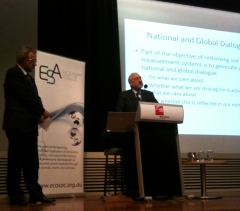
Today I had the pleasure of seeing Professor Joseph Stiglitz speak on the topic of From Measuring Production to Measuring Well-Being, courtesy of the Economic Society of Australia.
I became a fan of his following his timely defection from the World Bank as outlined in Greg Palast’s The Globalizer Who Came in from the Cold. I read this article in my formative days of studying geonomics. Palast writes –
So then I turned on Stiglitz. OK, Mr Smart-Guy Professor, how would you help developing nations? Stiglitz proposed radical land reform, an attack at the heart of “landlordism,” on the usurious rents charged by the propertied oligarchies worldwide, typically 50% of a tenant’s crops. So I had to ask the professor: as you were top economist at the World Bank, why didn’t the Bank follow your advice?
“If you challenge [land ownership], that would be a change in the power of the elites. That’s not high on their agenda.” Apparently not.
Back to today’s talk.
Stiglitz framed the discussion around the importance of accurate information, following his specialty of asymmetrical information. The core focus was the need for a Green GDP measure. Paraphrasing his speech, he mentioned:
“What is measured, affects what we do. The distortion created by price (what you can con the market in to paying for a piece of land, for example) rather than value (what can be realistically earnt from that location) causes multiple problems. This lured 40% of all US investment to be channeled into real estate, delivering phony profits. 40% of all corporate profits in the years running up to the GFC bust were in finance. Again these were phony profits, not based on any form of productive value, and so were wiped out by the subsequent market correction.
This was an example of the economics of information. Measurements like GDP included phony profits, making countries look better than what life actually is for those on the ground. ‘Bad accounting leads to bad decisions.'”
Stiglitz segwayed onto the UN’s Human Development Index. He gave the tentative thumbs up to such measurements of the quality of life, saying that incorporating both health and education with GDP per capita was a more rounded measure. Eyebrows were raised when he commented that more weighting should be given to the health and education sectors of the UN HDI than economic growth.
He went on: “It would be negligent of a business not to depreciate it’s capital. This is a key component that all investors consider. Why then do we not incorporate a measure on natural resource depletion?”
Other statistical discrepancies of note included the predominance of mean measures for analysing incomes. The tremendous increase in the ultra wealthy over the last 30 years has dragged the mean upwards. Stiglitz was adamant that ‘more than all the growth in wealth was going to the top, none to the bottom tiers of society’. Far more accurate was to look at medians – measuring the income of those people half way between rich and poor.
As he has throughout the tour, Joseph threw his support behind the mining tax.
“Why does America return such poor results for the 16 – 17% of GDP spent on health? We spend a lot for so little in return. Infant mortality rates are comparable to the Developing World.”
Thoughts flowed to Alanna Hartzok’s 2006 tour when she discussed the Health Olympics (the greater the wealth gap, the poorer the health).
“But yet GDP was pushed higher by poor health outcomes (requiring even more spending).” Why not a similar Defence Spending Olympics as Joseph ridiculed how some US states spent more on new prisons than schools, despite the police and war efforts.
Professor Stiglitz concluded with the need for distinction between what society says makes it happy and what we end up doing. Families not eating together in the main was anathema to the common belief of the family first.
Measurements must reflect what we care about.
This brought me back to the MC’s opening remarks – ‘what doesn’t get measured doesn’t matter’. Why aren’t economic rents measured? Have we learnt anything from the land bubble – the giant black hole of economic analysis – that led to the GFC? Two income earners are working so many hours to cover the mortgage, no wonder they don’t eat together. How extensively would the Riches of Oz be unlocked if we captured the rents for all?
The question I would have asked if I had the chance was, ‘with price to value such an issue in a world of resource scarcity, when are we going to look beyond Reactive Economics (like struggling to find health finance) and look towards Preventative Economics (where our behaviour is influenced before the act)?’
Having sat directly behind Stiglitz pre-talk, I reminded my neighbour that I might have missed out on asking a question, but it was all about location, location. Soon Stiglitz had a copy of Hudson’s Counter-Enlightenment in the post talk rush to speak to him.
A quick prompt of him got the desired response – ‘I’m a huge fan of Henry George’.
With that I encourage you to read this insightful interview with Joesph Stiglitz (h/t – Geophilos & Wealth and Want:
Read More


