Interest Rates cause of Recession?

Karl FitzgeraldCommentary2 Comments

if it's the reason for a sale it must be true
Creative Commons License photo credit: megananne

Here we go again! The Reserve Bank is worried it raised interest rates too high. Is that what has caused this downturn?

The real cause of this looming recession is the rampant over investment in land. This has pushed land prices to double the long term average in Australia, at 6.6 times the average wage, rather than than the 3.3 long term average.

The further this divergence is maintained, the uglier this downturn will be. Fannae Mae type bailouts will not help. To answer why, we return back to elemental economics. The more we spend on rent to meet these high land prices, the less is left for investment and consumption. This flows through to a reduction in job opportunities and the closing of small businesses. Wages often fall as business struggles to meet its’ rental obligations. Properties are then foreclosed. Tears are shed. This happens repeatedly, approximately every 18 years. Read Fred Harrison’s Boom Bust to explain why.

Rental payments need to naturally fall back to the long term average of 3.3 years average wage. We can only live on easy credit for so long. Prolonging land prices at their current highs, like the Japanese tried to in the 90’s, will only prolong the recession. Let the market work it out.
Read More

Australia’s Tax Carrot has advantages

Karl FitzgeraldCommentaryLeave a Comment

Ross Gittins comments in Our Tax system should be different that the Swan Tax and Transfer review compares Australia’s tax take with OECD averages in an insecure light. Our company tax level is the eighth highest in the OECD and property taxes are 9% rather than the 6% average.

Lobbying forces are lining up to pressure for lower company, property and capital gains taxes. Gittins points out though that:

If it is true that we need to tax capital less because it is now so mobile in a globalised economy, all the more reason we should stick to our taxes on the one resource that is immovable, real estate.

Placing holding charges on land has been identified by the OECD as the most efficient way to raise revenue. So too agrees David Uren at the Oz

It is a long-established principle of taxation that the incidence should be greatest on the least mobile factors of production: hence higher rates of annual taxation on property are warranted, as too may be taxes on consumption.

We believe that company taxes can be lowered only when land based charges are raised. Land based holding charges have been the anchors to which the Great Australian Dream has been anchored. It has only been since the neo-liberal paradigm has taken off over the last 25 years that we have seen lower holding charges and thus higher land prices. Anyone for higher company taxes?
Read More

Annual Dinner – Our 117th!

Karl FitzgeraldEvents1 Comment

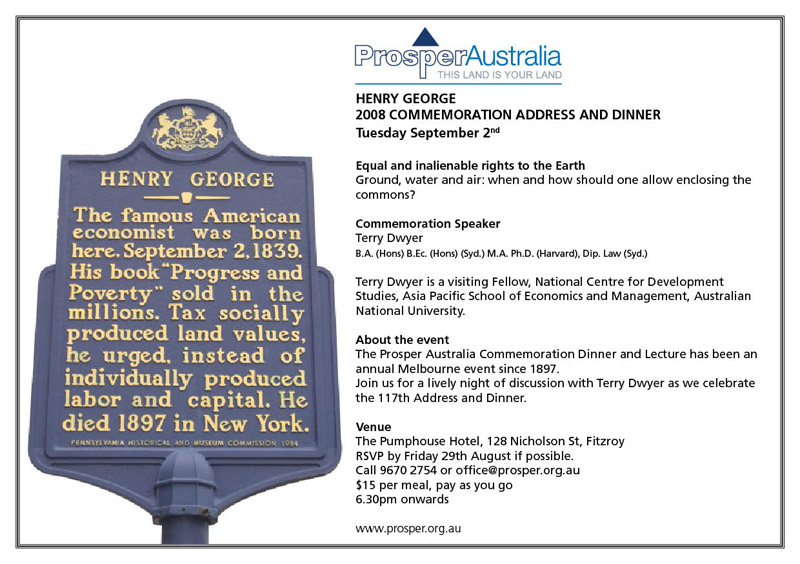
117th Henry George Annual Dinner
Tues Sept 2nd

Equal and Inalienable Rights to the Earth

— Ground, Water and Air: when and how should one allow Enclosing the Commons?

Download Flyer
This year we are fortunate to have Dr Terry Dwyer deliver the Commemorative Address. As a highly respected Resource Economist, Terry has chosen this year’s topic based on the omnipresence of resource privatisation. With water trading spreading in influence and Carbon Trading soon to be in operation, this address will be highly relevant to today’s hot topics.

Terry Dwyer is a visiting Fellow, National Centre for Development Studies, Asia Pacific School of Economics and Management, Australian National University. He is also a practicing lawyer.

This is a very special event on our calendar and has been held annually in Melbourne since 1897. Henry George was a highly influential economist at the turn of the 20th century who took the writings of Classical Economists to their logical conclusion: simplify business and community life by capturing most of the value the community and business create. He saw this value reflected in higher land values and controversially found that such land value appreciation could fund the abolition of all other taxes.
Read More

Bailing out the Bubble’s Enablers

Karl FitzgeraldCommentary, International1 Comment

the eye
photo credit: laurenatclemson

Michael Hudson

July 14, 2008

I am writing this article about Fannie Mae and Freddie Mac while sitting in the Queens Botanical Garden. This was not my plan today. The central air conditioning in my apartment broke down six weeks ago, and still has not been fixed. (It’s a nice condominium building, but accidents happen.) It is over 90 degrees outside, and nearly 100 as a result of the greenhouse effect in my apartment. Yesterday I took refuge in the Forest Hills Public Library, but it is closed on Sunday. One of the few libraries near public transport that normally is open on Sunday is in Flushing. So I went there to write the final draft describing the past week’s financial turmoil.

Unfortunately, when I got to the Flushing Public Library, a lady explained that because of the city’s budget cuts, the library no longer would be open on Sundays. Already before noon, when it was supposed to open, a large number of Chinese were waiting to get in, expecting to use the books and computer terminals. There was no sign explaining the situation in Chinese, and they continued to wait as I went down Main Street to the Botanical Garden.

At first glance this might not seem to have much to do with the turmoil of the last few days over the fate of Fannie Mae and Freddie Mac or the real estate markets they have helped inflate over the past decade. But actually, my experience today has everything to do with this topic. These two semi-public mortgage-packaging companies dominate the nation’s mortgage market and have supported real estate prices by steering over $5 trillion to enable homebuyers to bid higher and higher prices for homes, earning billions of dollars of bonuses, profits and interest for the bankers, mortgage brokers and Wall Street debt packagers who are the financial beneficiaries of the real estate bubble.
Read More

Overworked, Over thinking

Karl FitzgeraldCommentary1 Comment

Carol Nader reports in the Age that

HUNDREDS of children are spending 60 hours or more a week in child care, a Federal Government report has revealed.

The article then critiques the Federal Government’s policy of encouraging as many mothers as possible into the workforce. What are the underlying economic forces encouraging such workforce participation? We know that home owners are paying the highest amount ever recorded for land and housing, at 6.6 times the average wage, versus the long term average of half this.

Children are left in such long day care because families are struggling to pay for land. This flows through into prices for milk ($4 for $2 litres at the milk bar!!!), petrol and other key ingredients. As revealed at the recent ABC People’s Summit at the Victorian Parliament, the competition for limited child care places is also hindered by child care operators refusing to open more centres when the cost of land is so high.

Another reason is that workers are commuting longer and longer distances as ‘speculative sprawl’ forces them to chase affordable housing in areas bereft of public infrastructure such as child care centres and train stations.
Read More