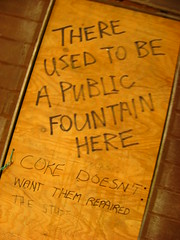
Privateering the Commons

Karl FitzgeraldCommentaryLeave a Comment

Commercialisation for whom?
Creative Commons License photo credit: Peter Blanchard

Renegade Economists Podcast 88

Subscribe to the podcast
As broadcast on the almighty www.3cr.org.au on Wed May 6th.

This week we discuss the frontiers of privatisation – from DNA to deserts to even the use of words! We also interview Mark Wakeham (EV) & Peter Campbell (Green Living Pedia) about Victoria’s pathetic solar feed in tariff. The protection of monopolists must stop!

Show Notes

Private v Public rights – how it deters effective policy making
We’re ‘labor’ing for polluters, we’re labouring for waste, we’re labouring to reward speculative largesse.

Solar Gold Rush
Overall, there are 107 solar energy project applications for BLM land in California.

The federal Bureau of Land Management has seen a 78% jump in the number of solar energy project applications since it reversed a controversial decision in July, 08 and started to accept applications again.

The Southwest desert’s real estate boom
Just 20 months ago only five applications for solar sites had been filed with the BLM in the California Mojave. Today 104 claims have been received for nearly a million acres of land, representing a theoretical 60 gigawatts of electricity. (The entire state of California currently consumes 33 gigawatts annually.)

It’s not just a federal-land grab either. Buyers are also vying for private property. Some are paying upwards of $10,000 an acre for desert dirt that a few years ago would have sold for $500.
Read More

Greenwash to wedge politics

Karl FitzgeraldCommentaryLeave a Comment

Steps in Aros Park 2
Creative Commons License photo credit: corvidmagic

The world of pass-the-buck hit home with Rudd’s cop out yesterday. It’s too hard for us, let’s ‘leave it to Obama to sort it out in Copenhagen’. Perhaps Obama has given the ALP a get out of jail card with the Democrat’s Waxman-Markey Bill beginning it’s long path through Congress. The US seems to be moving towards cap and dividend at worst, at best a carbon tax. That’s a long way from the unlimited importation of international Kyoto permits via the loophole ridden CPRS.

Smoke and Mirrors:

Meanwhile, the Government has thrown more compensation at big-polluting industry: more free carbon permits for the first five years, a low fixed permit price of $10 for the first year, and a 12-month delay to the entire scheme.

One of the side effects to the $10 carbon cap and the yearly delay is that is gives major emitters another year to buy carbon sinks (the carbon sequestration rights that forests enable). The $10 cap and the doubt the carbon reduction scheme raises will undermine the value of carbon sinks. Local dealings for carbon sequestration rights will put downward pressure on land prices in PNG’s forests (carbon sinks). With this doubt in mind, mining companies and the like will be hoping to fudge the true value of the massive carbon sinks in PNG, using this to wedge downwards the asking price of indigenous chiefs for their sacred forests.

This is a clear message to those tribal chiefs. DO NOT SELL YOUR LAND OUTRIGHT!

Only sell the carbon sink lease on a percentage basis. The mining company can claim the carbon credits if they pay you 25% of the value of those carbon permits, for example. The land does not need to be sold outright. Fishing, hunting and other customary rights can still be maintained.
Read More

FHOG = FOG

Karl FitzgeraldCommentaryLeave a Comment

View through fence
Creative Commons License photo credit: Hitchster

Renegade Economists Podcast 87

Subscribe to the podcast
As broadcast on the almighty www.3cr.org.au on Wed April 29th.

FHOG = FOG: John Poulter discusses Macquarie Bank, Postcode Swapping and the basic principles to a productive economy. Stop subsidising the wealthy with economic trickery!

Show Notes:

Anything in italics is an additional comment by us

End speculation on home buyers grant: HIA

HIA executive director Ron Silberberg has been lobbying the Government to at least retain the grant for newly-built homes.

“Our estimate is that if the Government retain the $21,000 grant for new housing and reverted to a $7,000 grant we would generate an extra 15,000 jobs in the housing industry and in manufacturing and service sectors.”

****this will push the value of new homes beyond the average first home owner, with well-to-do wage earners bidding up the price of new homes. This will push the rest of us to compete amongst the scarce old homes, forcing their prices higher too. The FHOG will be a wedge issue that will only serve to create short term jobs before the inevitable bust. The have’s and have-not’s will be on show yet again.

Landgrab deals: actually water grabs by Alex Evans

Over at ForeignPolicy.com, though, Nestle CEO Peter Brabeck-Letmathe has a different and interesting take on the issue:

The purchases weren’t about land, but water. For with the land comes the right to withdraw the water linked to it, in most countries essentially a freebie that increasingly could be the most valuable part of the deal. Estimated on the basis of one crop per year, the land purchased represents 55 to 65 cubic kilometers of embedded freshwater, an amount equal to roughly 1½ times the water held by the Hoover Dam. And, because this water has no price, the investors can take it over virtually free. It’s not quite a scenario from a James Bond movie, but the rush to lock up scarce water resources in agricultural belts is nonetheless disturbing. It suggests another food crisis might not be too far away.

In a sense, the great water grab is only prudent: Some 70 percent of all freshwater withdrawn for human use goes into agriculture, but underground aquifers are falling—in some regions by several meters per year—and rivers are running dry due to overuse. The worst problems are in some of the world’s most important agricultural areas: eastern Spain, the U.S. Great Plains, the Middle East and North Africa, and parts of Pakistan, northwest India, and northeast China. As the former head of the International Water Management Institute warned, “We could be facing annual losses equivalent to the entire grain crops of India and the U.S. combined” if current trends hold.

Music

DJ Food – Centre of the Earth
Son of a Bricklayer – Bloom
Carlos Nino – Lonely Joined by Happiness
Read More

Populationist Pressures Unravelled

Karl FitzgeraldArticles, Commentary, InternationalLeave a Comment

trust
Creative Commons License photo credit: notsogoodphotography

Can land tenure reforms eliminate the neo-Malthusian poverty-environment trap?

High birth rates predominantly occur where health and education is low. This in turn results from a negligent revenue raising system. Check the United Nations World Population Prospects report list of population growth rates by country and you will see a dominance in the higher echelons of poorer countries.

Ethiopian farmers have 8 kids because they know only a few will survive. When resource rents are recycled amongst the people rather than into the deepest pockets of the wealthiest, respectable health and education funding is possible.

This critique of Malthusianism by no means discounts the immense challenges we face with desertification, water scarcity or wilting crop yields. We are interested in opening up the discussion to the wider market imperfections that lead to higher populations, the ignorance of eco-systems AND the speculative lure of commodity markets.

Whilst cultural and religious aspects may impact on population growth rates, the effect of the wealth gap dominates. The health olympics is a worthy study which re-iterates that regardless of the health spending, unless the over-riding economic policy encourages opportunity and equality, health efforts will be undermined. We need to be able to put food on the table to remain healthy.
Read More

Earth Day upside down

Karl FitzgeraldCommentaryLeave a Comment

Stop Sign
Creative Commons License photo credit: anarchosyn

Renegade Economists Podcast 86

Subscribe to the podcast
As broadcast on the almighty www.3cr.org.au on Wed April 22nd.

Down under, upside down view of the world and the economics that sculpts it as we interview Environmental Lawyer Kim Lovegrove on the Carbon Pollution Reduction Scheme and lay out the future litigative pathway some babyboomers will face. Like the boomer track? Pension Tension by Cactus on Fire

Download the legal summary of the CPRS Bill from Lovegrove and Lord

Show Notes:

Emissions targets to be part of the Budget

To be budgeted out of existence? Britain has decided not to buy up carbon credits but to reduce emissions domestically

The Government will next week announce a groundbreaking, legally-binding target to cut Britain’s carbon emissions by at least 34 per cent by 2020 to combat climate change.

Ed Miliband, the Energy and Climate Change Secretary, told The Independent yesterday that the Government would not achieve the target by buying large amounts of “offsetting” credits – effectively paying poor countries to cut carbon on Britain’s behalf. Instead, it will cap the proportion of the target that can be achieved by offsetting.

“I want to achieve as much as we can through domestic action,” he said. “There will be a cap on credits from overseas. We are going to be sending a strong signal about that.”

Peter Barnes on Cap and Dividend
Read More