Gen Y Housing Market Sleeper Election Issue

Karl FitzgeraldCommentary12 Comments

IMG_6914
Creative Commons License photo credit: dbgg1979

Today’s Crikey had this corker:
The housing market:

Ben Loiterton writes: I am hoping you are alert to a gigantic sleeper issue building up steam in the community, although I haven’t seen any commentary from you at all.

The issue is the alienation of the entire younger half of the population from the housing market as the bubble keeps inflating due to deliberate Government policies and the relaxation of laws allowing foreign home-buyers to bid up prices.

Even though we have the most expensive (and over-geared) houses in the world, it seems all the baby boomers really don’t want a house price correction — which is not surprising give they own 95% of the equity in Australian residential assets. Also seems the banks are not too keen either now that they have given up on being commercial banks (lending to businesses) and have, in effect, become giant mortgage funds … (that in itself could be a big problem for the country if the bubble deflates!).

Most folk under the age of about 40 in this country are simmering with anger — either they cannot get into the market and are paying record rents, or they are in the market in tiny units and semis but can’t afford to upgrade to family homes when they have kids.

The resentment is starting to really boil — just see the reaction/comments to articles like this yesterday.

The Ruddites relaxation of restrictions on foreigners buying residential property to put a floor under property prices at the exclusion of Australian homebuyers is simply outrageous. More and more young people are becoming outraged by the bubble and the government’s direct support for it as all in the name of protecting boomer’s housing equity and bank balance sheets – but having the effect of financially ruining the next generation or excluding them from the Australian Dream.

This could be a big vote swinger in Gen Y, most of whom voted for Kev07. Climate change and health might seem to be the electoral issues of the day, but this generational wealth injustice is fast emerging as the main issue facing young Australians trying to establish themselves in the world.
Sustainability’s Transition Decade

Karl FitzgeraldCommentary1 Comment

andyK2_SLF2010_web

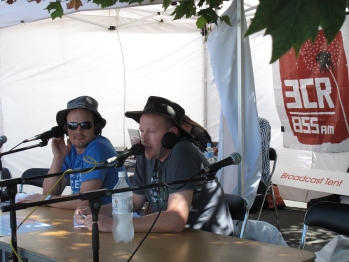
Taking our lead from a superb weekend of discussions amongst a gamut of switched on thinkers at the Sustainable Living Festival, Karl Fitzgerald and Andy Moore presented the Renegade Economists live from the event.

During the show we ran through a dream list of predictions for a Transition Decade to sustainability

Listen to the show (right click to download) as we make our way through:

    2010

  • Speculators Savaged by GFC
    2011

  • Vested Interests Exposed
  • Lobbyocracy Outlawed
    2012

  • The People Awaken
    2013

  • Election based on Geonomics Tax Reform
  • Income Tax Halved
  • Stamp Duty abolished
  • Land Rent system imposed (5% on yearly land valuations)
  • Carbon Tax system starts with great fanfare
  • Profits soar in green industries
  • Affordability improves
    2014

  • Geonomics system expands
  • Payroll Tax removed
  • Company tax abolished
  • Resource Rents capture 80% of mining profits
  • Natural Monopolies pay annual license on value of privilege (ie banks, phone, water companies)
  • Wage levels shoot up as less paid in rent
  • Tax incentives for localised bio-char projects
  • Council rates change to Site Value only (improvements no longer taxed)
    2015

  • Scare campaign by vested interests shot down by Chris Judd
  • Urban Density, walkability jump
  • Citizens paid for Eco System Services management
  • Community Land Trusts surge in popularity
  • Lord Mockton admits he was wrong
    2016

  • 7th new (magnetic) train line built in Melb
  • 60% of houses have govt funded solar/ micro power generation
    2017

  • Carbon Taxes increased, air pressured cars outsell petrol
    2018

  • Extra government finance piled into saving plankton (possible as
    tax havens now rendered obsolete)
    2019

  • Govt encourages people to work from home
  • People work less hours as less needed for mortgage
    2020

  • Greens around the world are thanked for saving the planet

Goldman Sachs Manipulates Monopoly Powers in Greece

Karl FitzgeraldCommentary1 Comment

Planet Gothenburg #photog
Creative Commons License photo credit: mescon

The merchant banker’s millionaire formula has been exposed yet again, this time in Greece. A country whose public finance mechanism has been undone over decades of lobbyocracy was left with little choice but to sell off its crown jewels.

It has been widely reported that Goldman Sachs helped create off sheet balance accounts where finance was provided in return for swaps to the rights to highways, airports and even the national LOTTO.

This is the merchant banker’s dream. The ticket to an ever lasting free lunch, bankers get to ramp up the fees for airport parking and highway tollbooths according to the projected desires of their next round of bonuses.

Taking ownership of LOTTO defines a new paradigm of monopolistic dominance over a society. One wonders why Macquarie Bank hasn’t thought of this earlier?

Now the vested interests have wound down our wages so much through land price appreciation/ aka asset bubbles that our employers have little to pay us.

For many people, gambling on a LOTTO ticket is our last remaining hope. And guess who now benefits from that in Greece? The people who have manipulated the people’s opportunity into their billionaire bonuses.

Will the home of democracy be the 2010 ‘tip of the iceberg’ that brings a sense of futility to democracy without economic justice?

Free TV Handout Outrage

Karl FitzgeraldHot IssuesLeave a Comment

Tiny rainbow spectrum II
Creative Commons License photo credit: OiMax

Not only has the public re-organised spectrum space for the broadcaster’s new channels, but we’ve also gifted a rebate on their licensing fees! Some sort of Digital Dividend, Mr Conroy! A dividend for whom? Where will the missing $200 – $500m p.a come from?

The broadcasters should be paying more for the added access to the commons, not less. A yearly licensing fee commensurate with the value of the spectrum should be implemented.

With the upcoming 4G license to be auctioned, the spectrum issue is heating up. Crikey’s investigative team reveals there’s a lot more to the story:

Free TV Handout’s – We Don’t Know the Half of It
by Crikey’s Glenn Dyer and Bernard Keane

The competition regulator should step in and force Free TV Australia, the television broadcasting cartel lobbyist, to change its name. There’s now no such thing.

A Crikey analysis has shown that the promised licence fee rebates of 33% this year and 50% next year to the television networks will be much greater than previously thought. Rather than $250 million, the likely cost to taxpayers will be closer to half a billion dollars from the Rudd Government.

Which means the free-to-air networks will cost us more than $20 a head for every Australian over the next 17 months.

Based on likely growth in advertising revenue as the economy accelerates, big sporting events such as the Commonwealth Games and the advertising frenzy of a federal election, the rebate could conservatively yield about $240 million in 2010 and $300 million or more in 2011.

Looked at another way, the roughly $500 million involved is 25% of the combined budgets of the ABC over the current and 2011 financial years. Imagine the complaints from the television networks (and not to mention News Ltd, Fairfax and Foxtel) if the ABC got a budget increase of that scale.
Read More

The Best of Intentions

Karl FitzgeraldCommentary, HistoryLeave a Comment

Creative Commons License photo credit: JPD Photos

AN EXPERIMENT IN INDIA

The much travelled and well known author, Karl Eskelund, whose many books on foreign countries and their people have countless readers, describes the effort which a band of young American and English Quakers made in the way of assisting some of the Indian population, millions of whom live at starvation level.

The young idealists took up their task in 1946 at the village district of Pifa, which lies in the Ganges delta, 45 miles east of Calcutta and four miles by bus from Basirhat railway station. They were fully aware that their work would test their patience, for in India you can get no results “at five minutes past twelve.” But after having outlined their plans to the peasants, the fishermen and the landowners, which met with general approval, they organised a co-operative enterprise in cultivating the land and in marketing the produce. They set up day schools for the children, evening schools for adults, clinics, etc.

After overcoming the initial difficulties, they saw signs of progress; inspiration grew. Health conditions improved. All took greater interest in their work and their earnings increased. New ideas took shape – there was advance along the whole line – an advance, slow but sure.

Five years after the experiment began Karl Eskelund visited Pifa and with one of the Quakers as his guide, he went through the village to see how it was faring. The Quaker had lost more than two stones in weight and was as thin and spare as the natives. But what was worse, he had lost heart because the experiment had proved a total failure. The day school still existed, but only one-fourth of the children attended it. The evening school was closed.

The clinic was hardly used. Agriculture, fishing and trade were back again to old methods. The author asked for an explanation of this fiasco. The young Quaker offered quite a number of reasons, none of which he could accept.

Finally he got to the root of the matter. This is what he says:- “In the first year after beginning the experiment, both peasants and fishermen earned more than ever before. What was the result?”

“The large landowners at once raised their rents and the smaller landowners followed suit. The peasants had to pay more for permission to cultivate the land. The fishermen had to find more money to buy permission to cast their nets on the flooded fields. In that way practically the whole of the increased earnings passed into landowners’ pockets.”
Read More