
Crisis in Democracy Looming

Karl FitzgeraldCommentaryLeave a Comment

Hush
Creative Commons License photo credit: unusualimage

Sometime soon someone will write an article on how lobbyocracy has subverted the public’s interest at the expense of the community’s in a staggering number of projects. One just has to have read John Perkin’s Economic Hitman to understand that the major projects announced in Victoria (Channel deepening, North- South pipeline, De-Sal plant plus roads and new rail) all tie back to one or two lobbying firms representing major firms like Veolia (water). Interestingly Veolia seems to be influencing up on NSW as well, where Kellie Tranter writes this key article:

Premier Nathan Rees was quick off the mark to announce that Sydney’s water supply is secure for the next 50 years with Veolia Water – a private company – being granted a licence to draw from the Fairfield Sewage Treatment Plant, recycle the waste and sell it. On top of the desalination plant – which coincidentally is also being built by Veolia Water and John Holland Group Pty Ltd – this will, we’re told, have a positive effect on dam levels.

The article that got me going was Lobbyists Win Labor’s Ear

LOBBYING firms with close links to the State Government have been involved in at least a quarter of the major development projects fast-tracked by the Government since February.

Projects such as a massive apartment development on St Kilda Road, the Pentridge Prison redevelopment and plans for the development of the Chirnside Park golf course site have been supported by lobbyist firms Hawker Britton and CPR, both with strong links to the Labor Party.
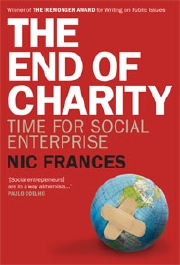
The End of Charity

Karl FitzgeraldCommentaryLeave a Comment

end-of-charity-cover-small

Renegade Economist Podcast 90

Subscribe to the podcast
As aired live on Wed May 20th, 2009 via radio on the almighty www.3cr.org.au

The End of Charity: Author & World Economic Forum insider Nic Francis talks about how we can shape market forces to reflect the moral values we need in a climate altered world.
Listen to the 12 minute interview:
Nic Francis pt1
Nic Francis pt2
Nic Francis pt3

Show Notes

Property speculation an ethical investment?
‘It’s not just an investment, its a chance to freak with peoples lives’

Ridley Scott (director of Blade Runner) is rumoured to be in production for the Brave New World. Will he include a hopeful streak borrowing from Huxley’s introduction to his futuristic novel Brave New World?

The Savage (a white man raised by the Zuni people) is offered only two alternatives, an insane life in Utopia, or the life of a primitive in an Indian village, a life more human in some respects, but in others hardly less queer and abnormal . . . If I were now to rewrite the book, I would offer the Savage a third alternative. Between the utopian and the primitive horns of his dilemma would lie the possibility of sanity (in a community of Utopian exiles). In this community economics would be decentralist and Henry – Georgian . . . Religion would be the conscious and intelligent pursuit of man’s Final End, the unitive knowledge of the imminent Tao or Logos, the transcendent Godhead or Brahman.

Japanese economy goes from freefall to plummet Crikey E-News
Glenn Dyer:

The Japanese Cabinet Office revealed today that the Japanese economy suffered a crippling fall of 15.2% (annual) in output in the March quarter.

It was made more stunning by the revision of the fall in the December quarter to a nasty 14.4% (annual rate), from around 12.2% originally reported.

Quarter on Quarter the Japanese economy fell 4% in March from December. In contrast the US economy was down around 1.5% (6.1% annual in the first reading for the quarter).

European vacation Kohler:
Astonishing – For the Eurozone as a whole, GDP shrank 2.5 per cent in March quarter, compared to the December quarter (not an annual rate, as the United States reports).

German GDP fell 3.8 per cent, which is equivalent to an annual rate of -15.2 per cent (US GDP fell at annual rate of 6.1 per cent in that quarter). Germany, in other words, is in a depression.

Slovakia and Latvia – small, open economies that rely on manufactured exports – fell a staggering 11.2 per cent in the March quarter, an annual rate of -33 per cent.

AWB posts 62% drop in first half profit
AWB Ltd will not pay an interim dividend after its first half profit sunk 62 per cent on adverse seasonal conditions and weaker demand, but the wheat group sees improvement in the second half.

Timber Schemes expose power of tax
There was a 93% surge in money invested with MIS’s in 2003/04 (Australian Agribusiness Report 2004).

Beside the outrage over 10% commissions to financial investors, the big issue is the abuse of the taxation system to provide tax loopholes for tax dodgers. No wonder the social contract is under threat.

Timber Schemes expose power of tax

Karl FitzgeraldCommentaryLeave a Comment

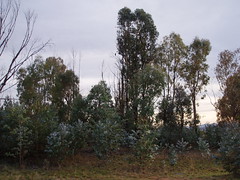
Gum Trees in Dawn Light
Creative Commons License photo credit: miak

The present collapse in Managed Investment Scheme’s was inevitable. The power of the tax system saw companies like Gunns planting trees around the clock in years gone by, just to meet the immense demand from tax-minimising activities. Kohler wrote in 2004 that upwards of 10 million gum trees were planted in the 10 preceding years, making then Taxation Commissioner Michael Carmody Australia’s most powerful greenie.

There was a 93% surge in money invested with MIS’s in 2003/04 (Australian Agribusiness Report 2004). Plantations could hardly keep up with the dual seller of ‘doing something good for the environment’ and engaging in ‘tax minimisation’.

Business Spectator’s David Leyonhjelm says in the Great Southern Sell-Off:

The MIS scheme was originally introduced to allow compensation for investors who otherwise would have to wait 10 years or more for their investment to mature. But many investments were made solely for the tax breaks rather than the investment itself. Some clever practices also emerged, such as non-recourse and round-robin funding, which gave the whole subject a bad name.

Beside the outrage over 10% commissions to financial investors, the big issue is the abuse of the taxation system to provide tax loopholes for tax dodgers. No wonder the social contract is under threat.
Read More

Norway’s oil rents irrational

Karl FitzgeraldCommentary1 Comment

Double barreled ninja attack
Creative Commons License photo credit: Aidan.Morgan

We read here how Norway’s oil rents have been more wisely invested than the UK’s. Fair point, but it still implies that we have failed to learn from the GFC:

Still, even Ibsen might concede that it is easier to stand alone when your nation has benefited from oil reserves that make it the third-largest exporter in the world. The money flowing from that black gold since the early 1970s has prompted even the flintiest of Norwegians to relax and enjoy their good fortune. The country’s G.D.P. per person is $52,000, behind only Luxembourg among industrial democracies.

As in much of the rest of the world home prices have soared here, tripling this decade. But there has been no real estate crash in Norway because there were few mortgage lending excesses. After a 15 percent correction, prices are again on the rise.

Why are rising property prices seen as a good thing? They are only good for speculators and bankers.

Everything is relative.

As we have commented on here, if oil rents are shared as citizen’s dividends, this is ok in the short term. In the long run, economic laws dictate that greater purchasing powers will only cascade into higher land prices if land rents are not collected. It is not rocket science, but one would think that a rational society would be going to any length to avoid similar GFC tragedies. Norway’s smug leaders must believe that land booms are fine for their generation. Little East Timor has outperformed them via their oil wealth investment strategy.

With corporate tax revenue plummeting and corporate suicides building by the day, we must avoid similar boom-bust economic cycles. Instead we see government’s globally engaging in massive infrastructure projects that will only make land in prime locations…more valuable.

This mentality is a neo-colonial hangover (MP3) where the economic profession outrightly supports those who own 80% of the planet to receive implicit subsidies through any improvement society makes.

We can only truly benefit from oil rents when land rents are also collected for the public good. The genuine resource curse is that we look at this problem with blinkers on. We must ensure all scarcity rents from natural resources and natural monopolies are recycled so that young drug takers realise there are creative, well paid jobs on offer. Who needs a gun when you have the best job you could imagine? Current policy making is selling future generations short and doing little to provide the vision that we are indeed rational.

Detroit Mayor Throws First Brick In Glass-Breaking Ceremony For New Slum

Karl FitzgeraldCommentaryLeave a Comment

detroit_article_largearticle_large1

DETROIT—As community leaders and members of the press looked on, Detroit mayor David Bing proudly hurled the first brick this week in a window-shattering ceremony for the city’s newest dilapidated slum.

The result of three years of construction work and more than $24,000 in public funds, the rat-infested and crime-ridden development was unveiled to the public on Tuesday.

“It is my great honor to introduce to you the brand new Baneberry Heights,” announced Bing, gesturing to the ramshackle subdivision behind him. “Filthy, dangerous, filled with violence and blight: It’s all here, and it’s all completely falling apart.”

Read more at The Onion – at it again in their sarcastic manner!…all we can do is laugh in this age of lobbyocracy.