Michael Hudson – Protecting the 1%

Karl FitzgeraldCommentaryLeave a Comment

Creative Commons License photo credit: Jesper Särnesjö

Renegade Economists Podcast 95

As broadcast on the mighty www.3cr.org.au on Wednesday June 24th.
Subscribe to the podcast

Show Notes:
Protecting the 1%: the grand theft continues as Prof Michael Hudson shines the spotlight on the financial warfare of today. Hear how the $12 trillion financial bailout is non-inflationary and how the pump priming has been replaced by the palm priming of the vested interests.

This is a must listen!

Read Hudson on Obama’s Financial Reforms.

Next week Hudson will discuss Latvia’s financial devastation through the prism of the Washington Consensus.

Music:
Logan Square (Rent’s Due) – Radius
Trouble Scene – M.W.D
Planetary Analysis – King Britt feat Rich Medina

Economic Slavery Explained

Karl FitzgeraldArticles, HistoryLeave a Comment

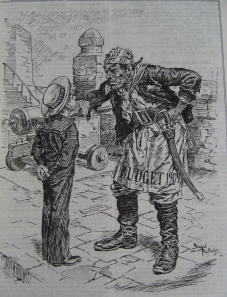
pirate-1909_web

THE INQUISITIVE BOY

By “SPOKESHAVE” (circa early 1900’s)
Out of the vault – this sums up our message like few others – please pass it on

What place is that, pa?
That is a brickyard, my son.
Whose brickyard is it, pa?
It belongs to me, my son.
Do all these piles of bricks belong to you?
Yes, my son, every brick of them.
My! How long did it take you to make them? Did you make them all alone by yourself?
No, my son; those men you see working there make them for me.
Do the men belong to you, pa?
No, my son; those men are free men. No man can own another. If he could the other would be a slave.
What is a slave, pa?
A slave, my son, is a man who has to work for another all his life, for only his board and clothes.
If a slave gets sick, who pays for the doctor, pa?
Well, his owner does; he can’t afford to lose his property.
Why do men work so hard, pa? Do they like it?
Well, no, I don’t suppose they do, but they work or starve.
Are these men rich, pa?
Not to any great extent, my son.
Do they own any houses, pa?
I rather guess not, my son.
Have they any horses or fine clothes, and do they go to the seaside when it is warm, like we do, pa?
Well, hardly; it takes them all their time to work.
What is a living, pa?
Why, a living – well, for them a living is what they eat and wear.
Isn’t that board and clothes, pa?
I suppose it is.
Well, are they any better off than slaves, pa?
Of course, they are, you foolish boy. Why, they’re free; they don’t need to work for me if they don’t like to; they can leave whenever they choose.
And if they leave, won’t they have to work, pa?
Yes, of course they will; they will have to work for someone else.
And will they get any more than a living from him?
No, I suppose not.
Well, then, how are they any better off than slaves?
Why, they have votes; they are free men.

Download the original
– one of our best documents!
Read More

Globalisation belittled

Karl FitzgeraldCommentaryLeave a Comment

Dare we mention that even the power of Starbucks is belittled by the ultimate monopoly power of the landlord! This is why we can benefit from $10 jeans (and say a prayer for the sweatshop workers as we hand over our money) but yet we still have no real improvement in our lives. Where has all that extra purchasing power gone now that we can buy a plate for 20 cents or a bike light for $2?

The law of rent sees that landlords can simply charge a higher rent as their monopoly power enables them to. “Either pay what I say or move to the boondocks.”

This can be locally reflected in Melbourne university apartment rents. The Bradley Report on higher education recommended higher Austudy payments. They ignored the added ability of landlords to scoop up any added earning capacity. Result – rents are to increase by 8% since last semester at University House on Swanston St. Extraordinarily, they have increased by at least 5% a semester since 2007.

Was that housing improved since the last semester? No. Did the locational value of the apartments improve? Yes. Was that the result of the property owners hard work? No. Was it due to the community’s natural development? Yes

Imagine the outrage if our bosses decided to cut our wages by 8% per half year?

Why are these publicly created values privatised? Learn more and then join our online course.

Sprawling Solutions

Karl FitzgeraldCommentaryLeave a Comment

Creative Commons License photo credit: optimal tweezers

Renegade Economists Podcast 94

As broadcast on www.3cr.org.au on Wed June 17th, 2009

Subscribe to the podcast by searching for ‘Renegade Economists’ in the Itunes Store. Please note that last weeks notes weren’t included as it was a radiothon special. We still owe $200 if you can pls pls support us.

Show Notes:
Sprawling Solutions – Rob Adams from Melb City Council discusses his report Transforming Australian Cities with some nifty policy angles to
curtail NIMBY’s. Dont forget Speed Renting June 23rd

Rob Adams Interview:
Listen to the interview
Transforming Australian Cities report

***In an extraordinary twist of fate, as we were interviewing Rob, Premier Brumby expanded Melbourne’s footprint by the size of Canberra, in effect snubbing Mr Adams highly practical report. To make matters maddening, Madden taglined the expansion as ‘Developing Melbourne’s newest sustainable communities’. Read our commentary and attached press release.

We did comment on earlier expansions during the show as per:
Brumby’s Sprawl-athon Unravels
PLANS to contain Melbourne’s urban sprawl are “stone dead” and the city’s cherished green wedge zones are in danger, according to a leading planner who has worked closely with the State Government.

Corporatisation of the Commons
Paul Hawken:What you have in place world wide is a huge number of very wealthy powerful companies who are driven to grow and penalised if they don’t. So they’re hungry and looking for a new market, and one of the things we’re seeing right now, particularly over the last decade, although we’ve seen it before, but it’s accelerating, is what I call the corporatisation of the commons, that is to say areas which we have for hundreds and really thousands of years, taken as common property, what we call the common wealth in traditional political terms, is now being privatised.
Read More