Renegade Economists Show 398
As broadcast on the 3CR airwaves 5.30 – 6pm Wednesdays.
Subscribe to the free weekly podcast.
Show Notes
Curtis Taylor (Bungol lands) and Suri Bin Saad, a proud Nyikina man from Derby (Kimberley region), discuss the proposed forced closure of remote aboriginal communities. What does it mean to the oldest known culture on the planet? What does it say about the priorities for stewardship of this dear earth? This despite billions made in mining and trillions in the ‘land game’.
Remote Community Land Grab by Renegade Economists on Mixcloud
Related Links
ABC on WA Draft Internal document on Forced Closures
The 75 category five communities were non-permanently occupied and assessed as high risk. There would be no further investment; only private investment would be possible. They could also include Goodalargin and Yallet. Dr Hames told Parliament people who chose to stay in country would do so without government support. The discussion paper said people who opted to relocate should be supported through long-term and flexible programs, and possibly new housing.
*** Workings: 3500 people need relocation = @ 2 people per house x $500K per house = $875m -> approximately $500 – $900m in set up costs plus relocation fees, psychological etc -> $1bn
Redman on royalties to fund remote communities, then slapped down
Redman said in December the $1bn “Royalties for Regions” fund, which is drawn from 25% of the forecast mining royalties paid to the state, could be used to support 274 remote communities threatened with closure after the federal government withdrew funding for essential services in November.
Assimilation and remote closures via Solidarity
Premier Colin Barnett was shown speaking in parliament about 38 reported cases of the STI gonorrea in minors, disingenuously ignoring the fact, pointed out by remote health workers, that most such cases result from the consensual sexual activity of young teens.
—
The NT Intervention poured hundreds of millions of dollars into the NT to build new bureaucracies of control. But the money available to Aboriginal people trying to live on their lands evaporated, almost overnight. The national Community Development Employment Program (CDEP)—which employed 7500 people across NT Aboriginal communities in a multitude of services from essential municipal works to schools, was shut down. Most of these people were simply put on the dole and subjected to “income management”.
The NT Government was simultaneously implementing reforms which saw around 50 local Aboriginal Community Government Councils disbanded in favour of a handful of “mega-Shires”. Many of the productive assets that communities relied on that were attached to the CDEP or the local council were simply confiscated, including earth-moving equipment, road graders, community buses and vehicles—essential equipment required for community life in remote areas.
While the Intervention was the main pretext for introducing this policy, it hit hard Australia wide. Almost 40,000 Aboriginal people had been employed on CDEP before its closure. Rene Adams, head of the Toomelah Aboriginal Co-op in North West NSW told Tracker magazine in 2012, “all people who were on CDEP are basically unemployed now… Mental health issues and suicides have increased. There’s more drugs, more violence, more alcohol. It’s heart breaking.”
Further cutbacks, despite millions in ‘inquiries’ to reduce deaths in custody
The federal government is poised to abolish the Custody Notification Service in New South Wales through a funding cut on July 1 – for the sake of saving A$526,000 a year. For that modest amount, the service provides NSW with one of the most effective strategies in curbing Indigenous deaths in police custody.
The service is a telephone hotline that provides Indigenous prisoners in police custody with personal and legal advice.
a “transparency measure” that “increases the professionalism of police”. It provides Indigenous people with assistance that is often:
… as simple as getting a person essential medication that can save a life.
——
In NSW, rates of Indigenous imprisonment are currently 24%. However, Indigenous people make up less than 2.9% of the population. This is a higher per capita rate than in the Northern Territory, where 86% of inmates are Indigenous. Indigenous people comprise 29.8% of the population.
It costs around $652 a day to lock up a young person in detention. It costs a lot less to educate and if required, rehabilitate a young person.
Interesting campaign – Just Reinvest
Good examples include:
– night patrols, such as the Redfern Streetbeat, the Bourke Community Assistance Patrol, the Grafton Streetcruize, the Dubbo Community Patrol
– mentoring programs, such as Tribal Warrior and the Australian Indigenous Mentoring Experience
– cultural centres, such as Tirkandi Inaburra and the National Centre of Indigenous Excellence.
Tough on Crime is Creating a lost Generation of Indigenous Youth
About half (52%) of young people in juvenile detention centres are Indigenous. The rate of imprisonment among Indigenous youth is 348 per 100,000, compared with 14 non-Indigenous youth per 100,000, aged 10 to 17 years, in juvenile detention facilities across Australia.
In practical terms, this means that Indigenous young people are 25 times more likely to be detained than non-Indigenous young people. This is an increase from 24 times more likely in 2011.
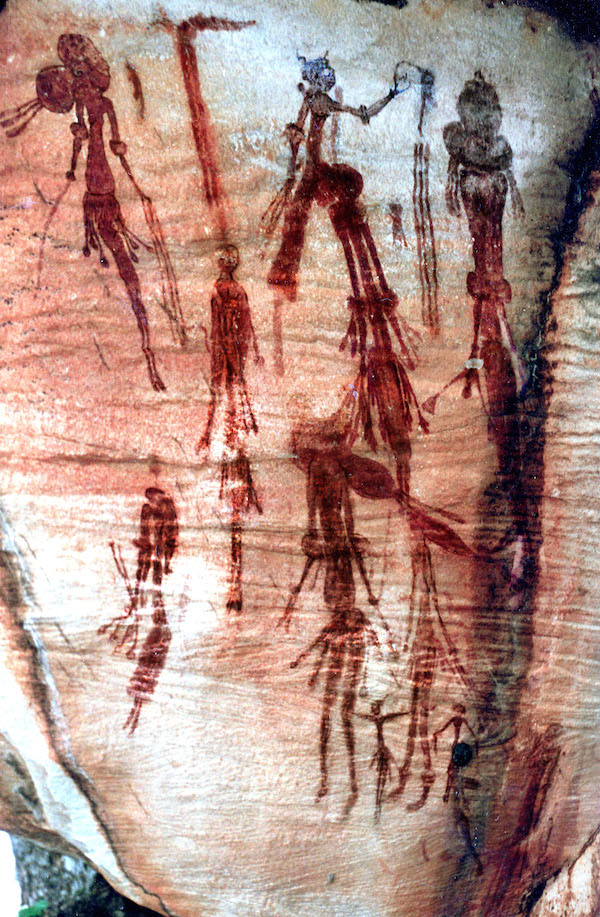
Image – Rob Hutton, Gwon Gwon Rock and Cave Art, Kimberley
Share with your friends, or if you could, provide an itunes review for the show. Thankyou!